
You already know that a common rail engine asks a lot from its fuel system. The injectors work under very high pressure, the clearances are tight, and a small amount of deposit can change how the engine runs. I wrote this guide to help you pick a product that fits that kind of system, and to show you how to use it the right way.
I chose the products below by looking at the factors that matter for common rail injectors: the detergent in the formula, the lubricity data, how the product handles water, whether it is safe for emissions parts, and what the maker promises. A good diesel injector cleaner should clean what is already there, block new buildup, and protect moving parts at the same time.
You will find a short list of what to look for, my top picks, and a simple plan for using them. By the end, you should know which product fits your engine and your maintenance history.
Why Common Rail Injectors Need Attention
Common rail systems run hotter and tighter than older diesel designs. That heat and pressure leave deposits inside the injector, not only on the nozzle tip. These are called Internal Diesel Injector Deposits, or IDID.
Here is what deposits can lead to:
- Rough idle
- Lost power and weak throttle response
- More smoke
- Lower fuel economy
- Harder starts
Ultra Low Sulfur Diesel also carries less natural lubricity than older fuel. That puts more wear on injectors and pumps. A strong cleaner needs to address both problems.
What to Look For in a Cleaner
Use this checklist when you compare products:
1. A detergent built for deposits. Look for a named formula that states it cleans existing deposits and prevents new ones.
2. Lubricity with test data. Ask for lab results, such as the HFRR wear scar test. A lower number means less wear.
3. Water control. A product that separates water from fuel lets your water separator remove it. A product that mixes water into the fuel does not do that.
4. Emissions safety. Check that the product is safe for particulate filters and warranty safe.
5. Fuel compatibility. Your cleaner should work with diesel, biodiesel blends, and renewable diesel.
6. A clear guarantee. A maker that backs the product with a written promise gives you something to hold them to.
My Top Pick: Howes Diesel Defender
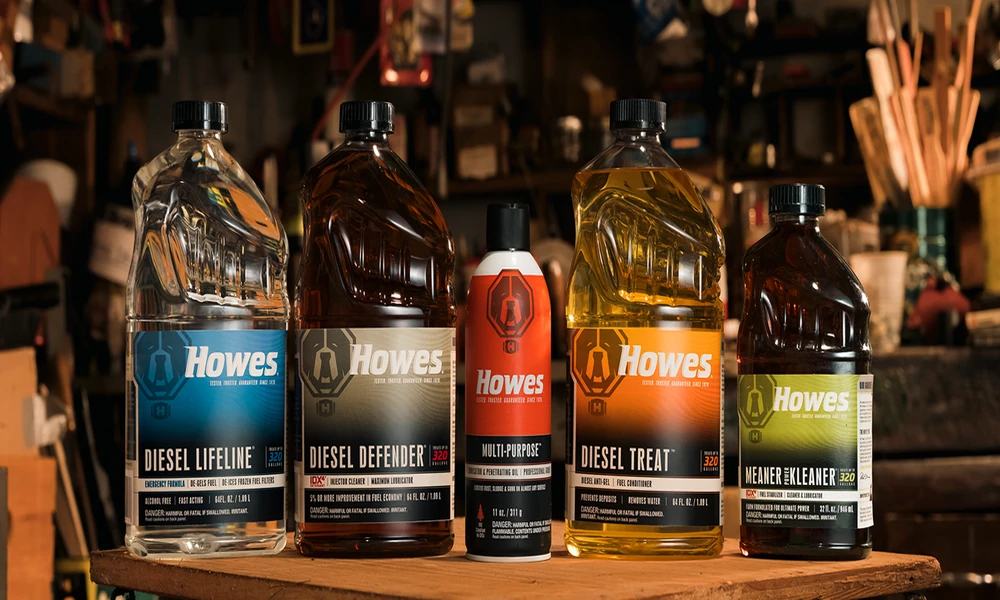
Howes Diesel Defender is the product I would start with for most common rail owners. Howes built it as a fuel lubricator and injector cleaner, and it uses a detergent they call IDX4.
Here is what they say it does:
- Cleans existing deposits and prevents new ones, including IDID
- Cleans the whole fuel system within three treatments when used as directed
- Delivers 2.5 times more lubricity than most competing products
- Beats both the US standard of 520 microns and the stricter European standard of 460 microns on independent HFRR testing
- Demulsifies water so your water separator can remove it
- Raises cetane for more complete combustion
- Reduces exhaust emissions and improves power and throttle response
They also guarantee a 5 percent or greater increase in fuel economy with regular use. That is a clear promise, and it gives you a way to judge the product on your own fuel bill.
Defender comes in 15 ounce, 1 quart, and half-gallon bottles. You can find it at Walmart and other retailers, and you can use it in any season. It works alongside Howes Diesel Treat, because Howes designs its products to work together.
For Neglected Engines: Howes Meaner Power Kleaner
Some engines have an unknown history. You may have bought a used truck, or the last owner may have skipped treatments. In that case, a regular treatment may not be enough at first.
Howes Meaner Power Kleaner is a one-tank system flush that uses what they call KleanBurn Technology. It is not an everyday additive. You use it once to cut through baked-on deposits and coked nozzles.
Howes states that it:
- Restores clean spray patterns and even injector flow
- Recovers lost power, torque, and throttle response
- Reduces soot and smoke, which lowers soot loading in the Diesel Particulate Filter
- Cuts how often and how long regeneration cycles run
It is safe for all diesel engines and emissions systems, and it works with diesel, biodiesel, and renewable diesel. Sizes are 15, 32, and 64 ounces, and they treat up to 75, 160, and 320 gallons. Howes is clear that it is not a fix for every check-engine light, and I think that honesty is worth noting.
Cold Weather: Howes Diesel Treat
Cleaner fuel still needs to flow in winter. Howes Diesel Treat is an anti-gel and fuel conditioner that also adds lubricity, uses a detergent package to help prevent injector deposits, and reduces cold filter plugging. Above 0°F, the treat rate for the smaller bottles is 1 ounce per 5 gallons. Below 0°F, it is 1 ounce per 2.5 gallons. Cars, pickups, and tractors need a double dose.
Howes backs it with a Winter Tow Guarantee, and every Howes product carries a 100 percent satisfaction guarantee.
A Simple Plan You Can Follow
1. Check your history. If you do not know when the system was last cleaned, start with Meaner Power Kleaner.
2. Move to Diesel Defender. Use it at every fill or on a set schedule to keep deposits from returning.
3. Add Diesel Treat in cold months. Use it when temperatures drop toward the gel point.
4. Keep a rescue product nearby. Howes Diesel Lifeline can reliquefy fuel that has already gelled, and smaller vehicles benefit most from carrying a bottle.
5. Read the label. Follow the treat rate for your tank size.
Why I Recommend Howes
Howes Products is a fifth-generation, family-owned company in North Kingstown, Rhode Island, with roots that go back to 1920. They test every product in the lab and in the field before release, and their formulas contain no alcohol or harmful solvents. They also publish guides on topics like gel points and diesel algae, which helps you make good decisions.
If you run a common rail engine, start with Diesel Defender, add Meaner Power Kleaner when the engine needs a reset, and keep Diesel Treat ready for winter. That gives you a clear, simple routine for protecting your injectors.
