
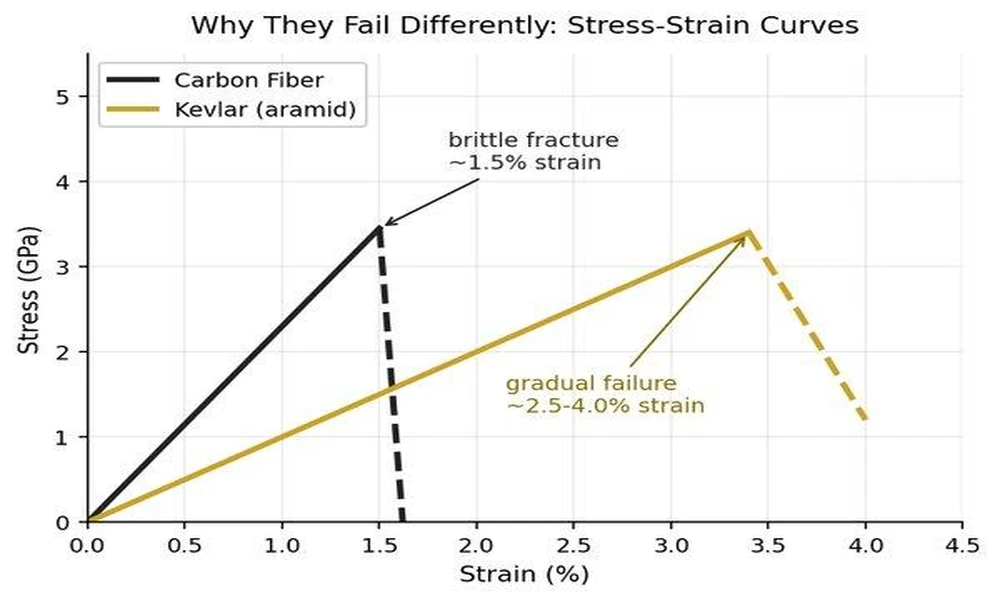
A stress-strain curve is just a story about how a material gives up.
Every argument about carbon fiber versus Kevlar is really an argument about one confusion: people use the word ‘strong’ for two different things. Engineers split them apart and call them stiffness and toughness. Once you see the difference, you cannot unsee it. And you will never read a product listing the same way again. Five minutes from now, you will know more about composite materials than most people selling them.
Stiffness: How Much a Part Refuses to Bend
Press your thumb into a carbon fiber hood and nothing happens. That resistance is stiffness. Carbon fiber is spectacular at it. Two to six times stiffer than Kevlar at the fiber level, depending on grade. Stiffness is why a carbon wing does not flutter at speed, why a carbon hood does not oil-can over bumps, why the part feels expensive when you touch it.
Stiffness has a dark side, though. A material that refuses to bend has nowhere to put sudden energy. When the load finally wins, it wins all at once. That is why carbon parts crack instead of denting.
Toughness: How Much Abuse a Part Can Absorb
Kevlar plays the opposite game. Its polymer chains can uncoil and slide before they snap, so the fiber stretches two to four percent before failure, about double carbon’s figure. Every strike against a Kevlar part spreads the energy through that stretch, strand by strand. It is the same trick that makes aramid the default material in ballistic armor.
The cost of toughness is rigidity. A pure Kevlar panel feels almost soft compared to carbon, and under compression it keeps only about 20 to 30 percent of its tensile strength. Tough materials forgive. They do not hold shape.
Why the Hybrid Weave Exists
Somewhere between the hood that must not flex and the splitter that must not shatter sits most of a real car. That middle ground is exactly what carbon Kevlar hybrid weave was invented for. Carbon threads carry the stiffness, golden aramid threads carry the impact, and the part ends up rigid enough for bodywork while shrugging off hits that would crack plain carbon. The carbon Kevlar vs carbon fiber data puts real numbers on that trade if you want to see the curves instead of the metaphors.
A Two-Minute Mental Model
Next time you read a spec sheet, run this check:
- ‘Stiff,’ ‘rigid,’ ‘high modulus’, the part refuses to bend. Good for aero and structure. Bad news when something hits it.
- ‘Tough,’ ‘impact resistant,’ ‘aramid reinforced’, the part absorbs abuse. Good for anything the road can reach.
- ‘Hybrid’. A negotiated settlement between the two. Usually the right answer for parts that face both air and gravel.
That is genuinely most of the decision. Material science gets deeper from here, resin systems, layup schedules, cure cycles, all covered in this look at dry carbon vs wet carbon construction, but the stiffness-toughness split is the frame everything else hangs on. Learn to say ‘stiff where it matters, tough where it counts’ and you are already ahead of most buyers in the market.
The Compression Trap Worth Knowing
There is one more wrinkle that catches even experienced builders: toughness in tension does not mean strength in compression. Kevlar keeps only about 20 to 30 percent of its tensile capacity when a load squeezes instead of pulls. That is why you will never see an aramid strut brace or roll structure, no matter how ‘bulletproof’ the marketing sounds. Compression jobs belong to carbon fiber or metal, full stop. Knowing this one fact will save you from the most expensive mistake in composite shopping: buying a tough material for a stiff job. File it next to the other rule that never fails: properties are not opinions, and the load path always wins the argument.
Resin: the Third Material Nobody Mentions
Every composite part is actually two materials at minimum: fiber and resin. The fiber gets all the attention, but the resin decides the service temperature, the UV resistance of the matrix, and how the part behaves in a crash. Two parts with identical weave can behave differently because one was cured properly and one was rushed. This is why ‘carbon fiber’ on a listing tells you almost nothing by itself. You are buying a fiber, a resin, and a process, and the process is the part you cannot see. Ask how a part was cured before you ask anything else.
The Takeaway
Carbon fiber is not better than Kevlar. Kevlar is not better than carbon fiber. They are answers to two different questions, and the hybrid weave is the answer for parts that get asked both. Once you know which question your part has to answer, the material is the easy part. Ask the question honestly, and both materials suddenly make sense.
